Queer Places:
Harvard University (Ivy League), 2 Kirkland St, Cambridge, MA 02138
56 Beacon St, Boston, MA 02108, USA
Tuckernuck Island, Nantucket, MA 02554, USA
Mount Auburn Cemetery, 580 Mt Auburn St, Cambridge, MA 02138, United States
Homyoin-temple, 20-246 Onjojicho, Otsu, Shiga 520-0036, Japan
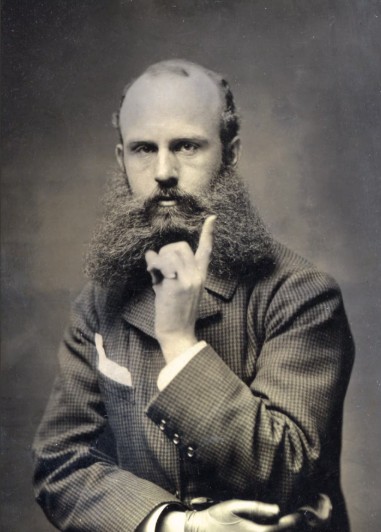 William Sturgis Bigelow (April 4, 1850 – October 5, 1926) was a central figure in Boston’s intellectual, artistic, and social elite during the Gilded Age. A physician by
training, a Buddhist by conviction, and a collector by passion, he occupied a unique space in the cultural history of both Boston and Japan.
William Sturgis Bigelow (April 4, 1850 – October 5, 1926) was a central figure in Boston’s intellectual, artistic, and social elite during the Gilded Age. A physician by
training, a Buddhist by conviction, and a collector by passion, he occupied a unique space in the cultural history of both Boston and Japan.
Born into a prestigious medical dynasty—his father was the noted surgeon Henry Jacob Bigelow—William Sturgis Bigelow graduated from Harvard College in 1871 and
Harvard Medical School in 1874. He continued his medical studies in Paris under the mentorship of Louis Pasteur. Despite his credentials, he found the practice of medicine
unfulfilling and eventually abandoned the field to pursue his intellectual and artistic interests.
Bigelow is perhaps best known for his pivotal role in Japanese art history and his contributions to the Museum of Fine Arts (MFA), Boston.
During his time in Japan (starting in 1881), he acquired thousands of works of art, including paintings, sculptures, and ceramics, at a time when many Japanese people
were discarding traditional items in favor of modernization.
He donated approximately 26,000 works to the MFA, forming the core of its world-renowned East Asian collection.
In acknowledgment of his efforts to preserve and elevate Japanese culture, he was awarded the Imperial Order of the Rising Sun (Commander rank).
Bigelow was a celebrated host who bridged the gap between Boston's "Brahmin" establishment and its bohemian fringe.
His townhouse at 56 Beacon Street, overlooking Boston Common, served as a hub for the city's intelligentsia. He hosted frequent, exclusive male-only dinners, drawing guests
ranging from literary figures to political heavyweights like his close friend Theodore Roosevelt, who often used the house as his Boston headquarters.
His most legendary social setting was his estate on Tuckernuck, a remote island off the coast of Nantucket. It functioned as a private sanctuary where guests could escape
societal pressures. The atmosphere was noted for its "medieval splendor" (in Henry Adams’s words) and unconventional rules, such as
the mandate for nudity during the day followed by formal dress for dinner. Bigelow, a physician, collector of Japanese art, and prominent figure in Boston society,
maintained this property as a private retreat. He hosted friends like Thomas Russell Sullivan,
Theodore Dwight, and George Cabot Lodge. The estate held significant
emotional importance for Bigelow; he was particularly close to George Cabot Lodge, whom he viewed as a spiritual son and intended to be the heir to his island property.
When Lodge died suddenly at the island estate in 1909, Bigelow was devastated, and the funeral services were held at his own home.
He moved in the same circles as Thomas Russell Sullivan and Isabella Stewart Gardner. Bigelow captured the attention of
Thomas Russell Sullivan, himself a key player (and good friend of Isabella Stewart Gardner) in Boston’s bohemia. Sullivan once reported to Gardner: “Sturgis Bigelow, MD, has
come in with hypnotic influence and carries me off to dine with him tonight, seductively, with the resident literati and tutti fruiti.”
The Tavern club was originally located at 74 Boylston Street, Boston, and its members included many gay men such as Sturgis Bigelow,
Dennis Miller Bunker, Bertram Goodhue,
Henry James, Augustus Saint-Gaudens,
George Santayana, and John Singer Sargent. Probably Sturgis Bigelow was the
model for Dr. Alden in Santayana’s The Last Puritan. Another gay man, Timothee Adamowski provided much of the lunchtime and
afternoon entertainment and performed at the club’s fist general meeting in September 1884. Women were not allowed in the clubs, which also included the heterosexual cream
of Boston’s male high society: Cabots, Lowells, and Oliver Wendell Holmes Senior and Oliver Wendell Holmes, Jr..
A man of diverse contradictions, Bigelow was an active trustee of the Museum of Fine Arts—often involved in the internal institutional power struggles of the time—while
simultaneously being deeply committed to Buddhism. He lived as a "gay blade" (a term of the era for a fashionable, hedonistic bachelor) and never married.
Upon his death in 1926, his commitment to his spiritual beliefs was solidified: his ashes were interred at Mount Auburn Cemetery in Cambridge, but in accordance with
his wishes, a portion was sent to Japan to be scattered at a Buddhist temple, reflecting his dual identity as a Boston Brahmin and an honorary citizen of the East.
References:
Other references:
- https://en.wikipedia.org/wiki/William_Sturgis_Bigelow
Support this project
This website is a passion project researched, developed, and funded entirely by me. If you find the content valuable and would like to help support the ongoing research and hosting costs, any contribution is deeply appreciated.
Thank you for keeping this independent resource alive!
My books on Amazon: Elisa Rolle's books
BACK TO HOME PAGE